Partial eclipse: totality will not be visible
- Obscuration
- 99.9%
| Phase | Sun altitude | |
|---|---|---|
| Begins | 07:40:52 UTC | 24° |
| Maximum | 08:46:53 UTC | 37° |
| Ends | 09:59:28 UTC | 52° |
The nearest totality is 4 km to the south.
In Sanlúcar de Barrameda the Moon will cover at most 100% of the Sun, at 10:46 CEST. There will be no totality.
| Phase | Sun altitude | |
|---|---|---|
| Begins | 07:40:52 UTC | 24° |
| Maximum | 08:46:53 UTC | 37° |
| Ends | 09:59:28 UTC | 52° |
The nearest totality is 4 km to the south.
Shown with the zenith at the top, as you will see it in the sky. Sizes and positions are computed; brightness is illustrative.
At maximum the Sun will be 37° above the horizon, to the east. Find a spot with no buildings or hills in that direction.
Spain’s National Geographic Institute (IGN): partial eclipse, maximum at 10:46:44 CEST, magnitude 1.IGN uses a different forecast of Earth’s rotation (ΔT): its times are about 9 seconds earlier. We show IGN’s duration when it is shorter than ours.
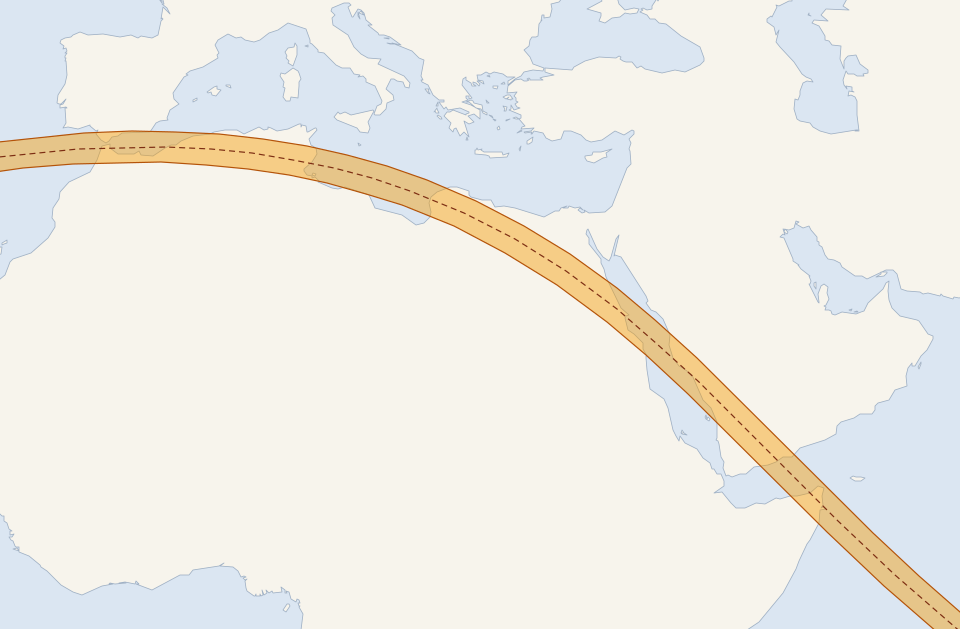
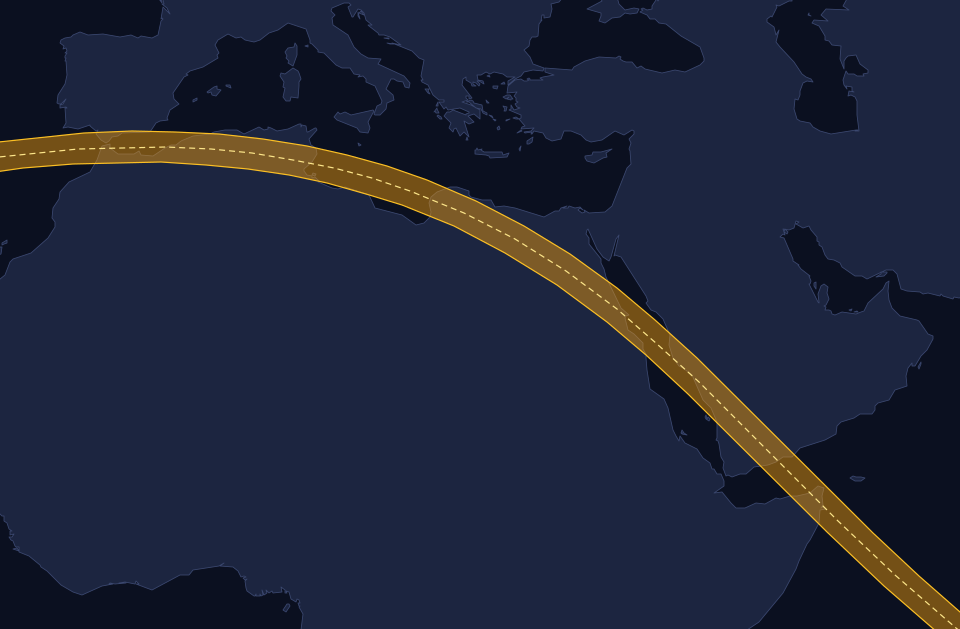 Sanlúcar de Barrameda
Free, no cookies and no ads. Copy the code and paste it into your page.
Preview
Only during totality and only inside the path: when the Sun is completely covered you can look with the naked eye. Before and after, and throughout a partial eclipse (even at 98 %), use glasses certified to ISO 12312-2. Ordinary sunglasses do not protect you.
It depends on the city. In mainland Spain it starts between 9:40 and 9:50 and ends between 11:55 and 12:13 (CEST); inside the path, totality happens between 10:45 and 10:53. In the Canary Islands the maximum is around 9:34 (WEST) and in Turkey between 12:38 and 13:04 (TRT).