Partial eclipse: totality will not be visible
- Obscuration
- 76.2%
| Phase | Sun altitude | |
|---|---|---|
| Begins | 07:49:23 UTC | 30° |
| Maximum | 08:54:29 UTC | 41° |
| Ends | 10:04:38 UTC | 53° |
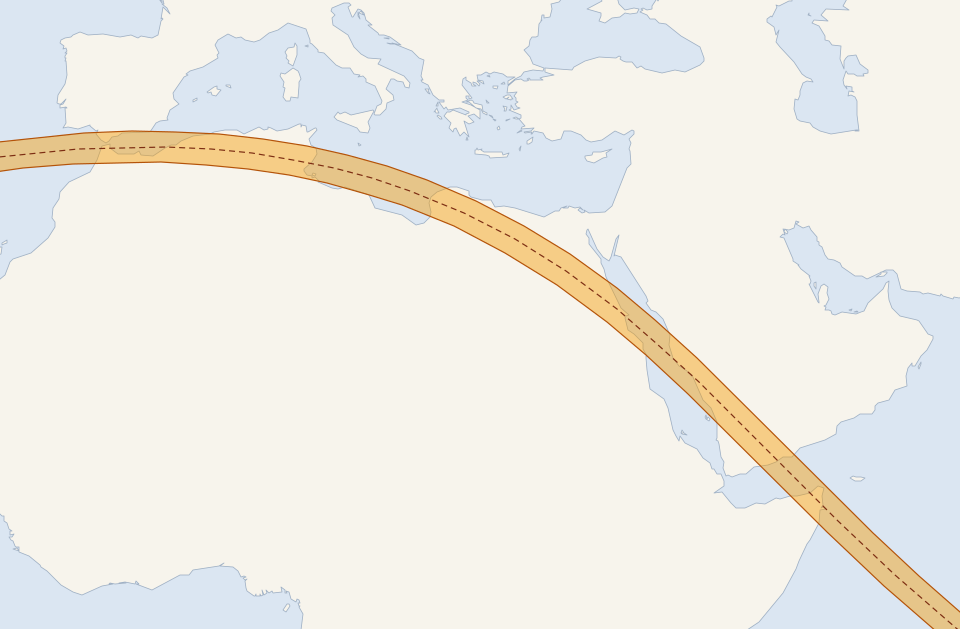
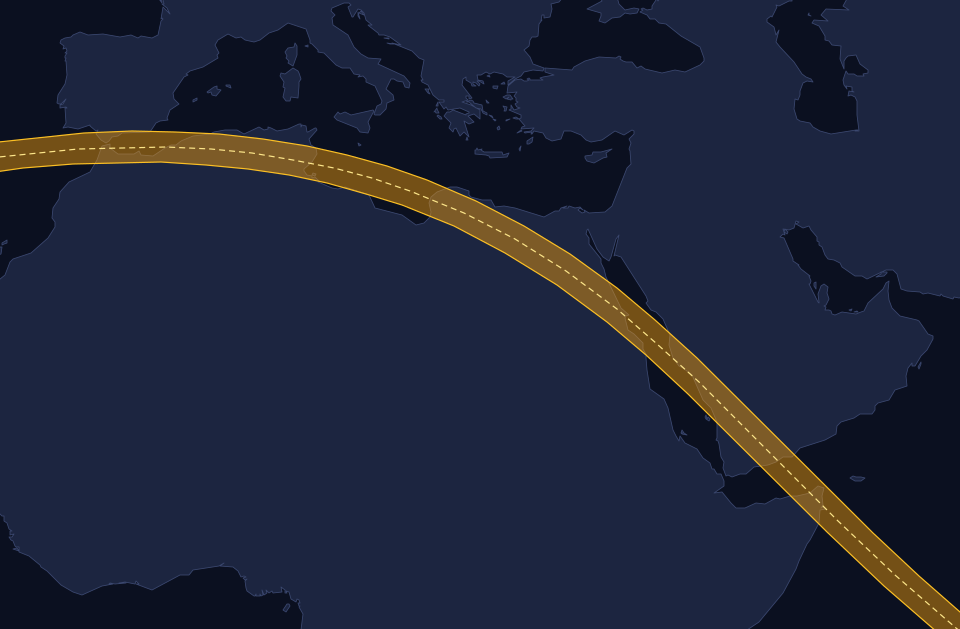
The nearest totality is 667 km to the south.
In Pamplona the Moon will cover at most 76% of the Sun, at 10:54 CEST. There will be no totality.
| Phase | Sun altitude | |
|---|---|---|
| Begins | 07:49:23 UTC | 30° |
| Maximum | 08:54:29 UTC | 41° |
| Ends | 10:04:38 UTC | 53° |
The nearest totality is 667 km to the south.
Shown with the zenith at the top, as you will see it in the sky. Sizes and positions are computed; brightness is illustrative.
At maximum the Sun will be 41° above the horizon, to the east. Find a spot with no buildings or hills in that direction.
Spain’s National Geographic Institute (IGN): partial eclipse, maximum at 10:54:21 CEST, magnitude 0.8.IGN uses a different forecast of Earth’s rotation (ΔT): its times are about 9 seconds earlier. We show IGN’s duration when it is shorter than ours.
 Pamplona
All cities: 2027 eclipse →Moon phases in Pamplona →
Free, no cookies and no ads. Copy the code and paste it into your page.
Preview
Only during totality and only inside the path: when the Sun is completely covered you can look with the naked eye. Before and after, and throughout a partial eclipse (even at 98 %), use glasses certified to ISO 12312-2. Ordinary sunglasses do not protect you.
It depends on the city. In mainland Spain it starts between 9:40 and 9:50 and ends between 11:55 and 12:13 (CEST); inside the path, totality happens between 10:45 and 10:53. In the Canary Islands the maximum is around 9:34 (WEST) and in Turkey between 12:38 and 13:04 (TRT).